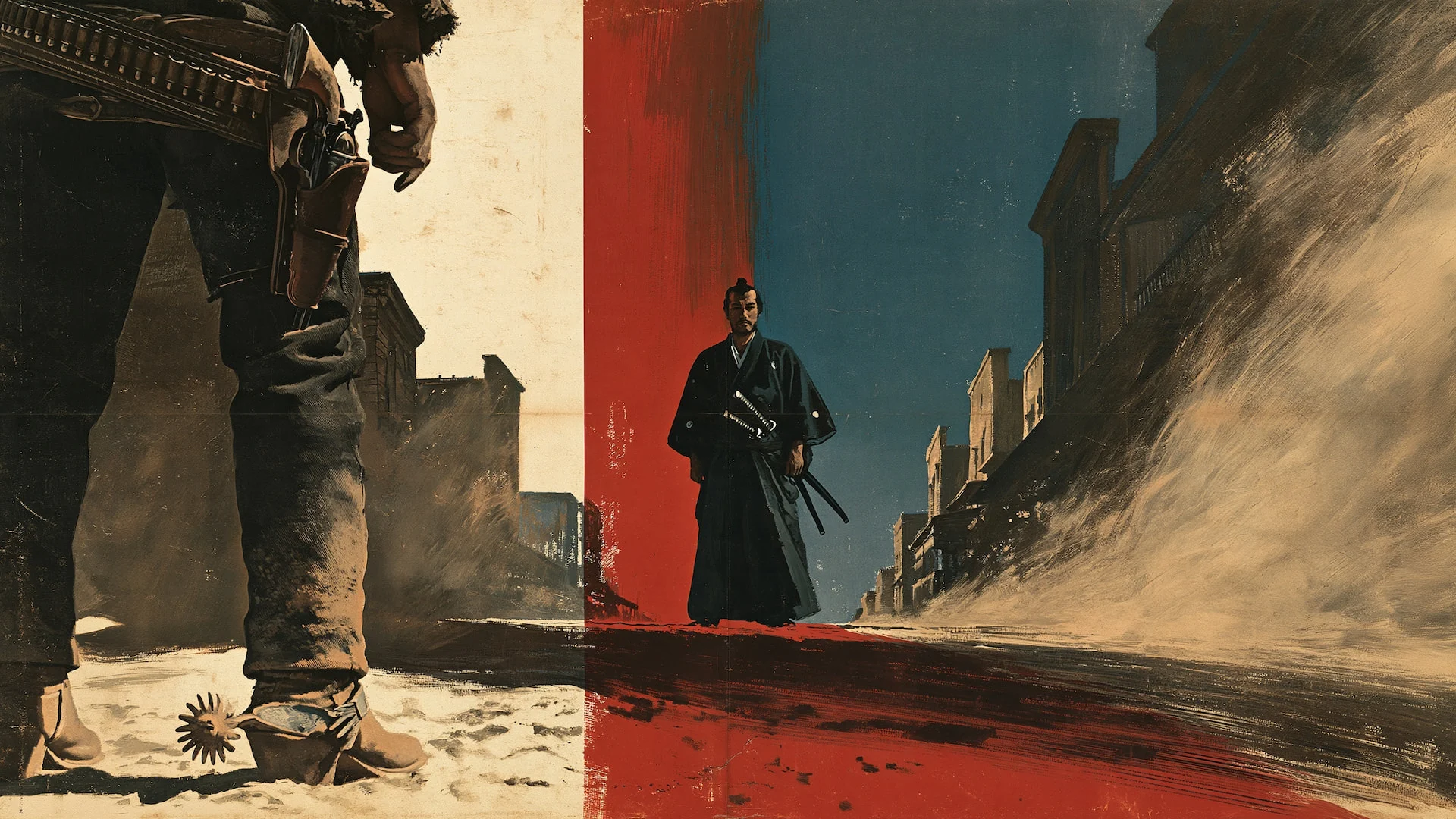
Two films telling the same story through different genres, actors, languages, even music. Did one steal from the other? Does it even matter?

When my dad really liked a film, he would record it from a live TV broadcast to a VHS cassette. Usually he didn't bother pausing for the commercial breaks. And now and then he'd record over something he'd captured earlier, so a football match might resume in extra time once the film was over.
This was the 1980s, a primitive era for home entertainment. But it means I can construct a canon from memory, the films that got the Dad Seal of Approval. The Godfather. Rocky. The Great Escape. Bullitt. Dirty Harry.
His favourite, though, was A Fistful of Dollars. I watched it with him when I was very young and understood almost nothing about what was going on. But I understood who the goodies and baddies were, eventually, and I understood the part towards the end where the man in the poncho is beaten to a pulp, escapes, and comes back to settle scores in the most epic style imaginable. Those scenes are very powerful when you're seven years old.
It was many years later, long after my father passed away, that I learned A Fistful of Dollars (1964) (opens in a new window) was an unofficial remake by Sergio Leone of Yojimbo (1961) (opens in a new window) by Akira Kurosawa. How much did the two films actually share? Was the original as operatic as the copy, or something else entirely?
So here's a double bill of villainy, betrayal and heroism-in-disguise, to see where they meet and where they part.
A warning before we begin: here be spoilers. If you haven't seen either, go watch them first and then come back.
The shadow of apocalypse
A ronin is a samurai with no master, which in practice means a swordsman with no wages, no address, and no one to answer to. Toshiro Mifune plays a ronin who calls himself Sanjuro, and he strays into a place that exactly reflects his state of being: a small town in 1860 that's completely devoid of order. Two criminal gangs are busily pulling it apart between them.
The first thing you notice about Mifune is that he can barely keep still. He shrugs, he paces, he rolls his shoulders, he scratches himself constantly. At a crossroads at the beginning of the film he throws a stick in the air and walks whichever way it falls. This is a man living moment to moment. Mifune said afterwards (opens in a new window) that the restless mannerisms were his own invention rather than anything in the script; he meant them to suggest loneliness.
What piques his curiosity is something small and domestic. A son shames his parents. From there, Sanjuro decides to meddle. He plays one group off against the other, partly for the money and partly because it's something interesting to do. But is that his only reason?
Gonji, an old innkeeper who helps him, is one of only two people left in town with any moral clarity, and he accuses Sanjuro of merely feigning indifference. Then the film shows you why the pretence is necessary. The moment Sanjuro is caught freeing a captive family, he's beaten half to death in revenge. The mask slips exactly once and it nearly costs him everything.
The tone is the strangest thing about Yojimbo. There's an apocalyptic shadow over the village, an ill wind that swirls dust down the town's single empty street. One of the first things we see is a dog trotting past with a man's severed hand in its mouth. Yet everybody except Sanjuro and Gonji seems cheerful about the disintegration of civilisation, like children dancing on a grave.
Then there's the gun. Unosuke, one of the villains, carries a pistol, and he's accorded special status because he's the only man in town who has one. This is the very end of the Tokugawa period, with the shogunate coming apart and Japan about to reorganise itself completely, and Kurosawa pins all of that significance onto one object. Every sword in the film is obsolete, and the men holding them know it.
The blocking is where Kurosawa is truly magisterial, and the final sequence is exhibit A. The camera holds one continuous space and hands you three things without a cut or a line of dialogue. It crosses a group of men playing cards for fun at the feet of an old man strung up and left hanging in the wind, rises to the old man's face so you can see he's still alive, then comes back down to the street as the alarm goes up and the gang assembles for the fight. Stakes, reassurance and odds in a single move.
A new location, and a new register
In Leone's retelling, the story moves to the American border and is carried by an unknown television actor called Clint Eastwood. It's still a flyblown town where the inhabitants hide in fear. But the register is quite different. Where Kurosawa pins his story to a precise moment in history, Leone strips the history out and turns it into myth: a man with no name, a town emptied of life, a time you can't place.
Eastwood does the opposite of everything Mifune does. He barely speaks, he carefully observes, and he moves through competing agendas at a leisurely pace, as though he has an appointment later. The acting happens in his eyes, squinting, usually over a cigar he's chewing rather than smoking. The stillness is the performance, inert until he has to flip back his poncho to reach for his gun.
I remember my dad's delight at a sequence very early on.
Joe informs one of the faction leaders he's available for hire, then strolls past the undertaker and tells him to get three coffins ready. He walks up to a gang of hombres who spooked his mule and quietly asks them to apologise to the animal. They laugh at the absurdity of it. The film cuts back and forth between Eastwood's face and theirs, and the laughter drains away as they realise he means it. Then the guns come out. On his way back past the undertaker, Joe corrects his order: not three coffins, four.
The punchline tickled my dad plenty, and it still makes me smile today.
(And that famous label, the man with no name, isn't strictly true. Exactly one person calls him Joe: Piripero, the undertaker, the same coffin maker from the joke my dad loved. The tag was cooked up later by United Artists (opens in a new window), to sell all three of Leone's films with Eastwood to American audiences.)
Everywhere else, the director pitches the action at full volume. Leone shoots his actors in enormous close-up, the villains sweating and grimacing at very close range, held in the frame for longer than the moment needs. In contrast, the town itself is wider and emptier than Kurosawa's single street, and aerial crane shots emphasise its desolation.
The villains are fewer in number but more distinctive than in Yojimbo. Ramón Rojo as played by Gian Maria Volonté is especially memorable. Like Unosuke, he's a younger brother to the gang's boss, but where Unosuke plays the subordinate, Ramón dominates every scene he's in. His introduction entails the massacre of a detachment of soldiers at the river with a mounted machine gun; you're left in no doubt as to what he's capable of.
Several other scenes have this streak of cruelty. Joe's tormentors have far too much fun kicking and stomping him around a storeroom. And the ambush of the Baxter family is just as disturbing as the equivalent scene in Yojimbo, if not more so. Men are shot down while surrendering and begging for mercy, and the killers laugh while they do it. Leone lingers over the barbarity with forensic detachment, the soundtrack taken up with gunshot after gunshot after gunshot.
And then there's the music. Ennio Morricone fills the soundtrack with whistling and trumpets, and builds several scenes to an operatic crescendo. It's memorable and hummable, a bona fide Ohrwurm, as we say in German. Masaru Sato's score for Yojimbo is jazzy and discordant, all sax and flute and crashing drums, but I couldn't hum a bar of it afterwards. The only sound that stays with you from Kurosawa's film is the howling wind.
What translated, and what didn't
The most obvious thing to survive the journey from the samurai film to the western is the figure of the anti-hero. Seemingly amoral and self-serving, he keeps his code of honour hidden. But travelling alongside him is a pistol, and it arrives on the other side changed.
In Yojimbo that gun represents the end of an era, an object that Kurosawa saddles with an ominous significance. In Fistful, Ramón looks at a pistol with contempt and picks up a Winchester instead, on the reasonable grounds that a rifle is more powerful. The idea hasn't vanished in the crossing, but it has moved further down the road. Kurosawa's pistol is the beginning of the end, and Leone's world, with its rifles and machine guns and dynamite, is what happens when everyone's armed.
Even the jokes get reworked. In Yojimbo, Sanjuro orders his coffins after the fight, correcting himself from two to three. Leone splits the line in two, ordering three before the shooting and four after it, and turns a throwaway remark into a setup and a punchline.
Leone does something smarter with the inciting incident, too. Kurosawa opens on a son shaming his parents, which is small and immediately legible, and Sanjuro acts on it. Leone drops that subplot completely and puts a different family in the opening instead, one being held hostage by one of the factions. We aren't told what we're looking at, and neither is Joe, until a key scene much later when the personal cost of the feud becomes impossible to ignore. Same position in the film, same job of putting the hero in motion, but the seed is planted early and the meaning arrives late.
Then the endings, which is where the two films part company for good. Both finish with our man needing to beat a better armed opponent.
Unosuke has the only pistol, so Sanjuro learns to throw a knife, and Kurosawa shows him practising by pinning a blowing leaf to a floorboard before he puts the blade through Unosuke's gun arm. Ramón has the rifle, and he's twice explained that you kill a man by shooting him through the heart. So Joe straps a steel plate under his poncho and invites him to try, whereupon Ramón empties the rifle into his chest.
Leone's is the more thrilling set piece by a distance. Joe appears through the receding smoke of a dynamite blast, the villains mock him for his stupidity, and then realise too late the joke's on them. Kurosawa makes the climax about Sanjuro getting better. Leone makes it about Joe getting smarter.
A dispute, then a settlement
So, what's all this about theft? Steve Jobs liked to quote Picasso as saying that good artists copy and great artists steal, though there's no record of Picasso ever saying it (opens in a new window). What's certain is that Leone didn't buy the rights to Yojimbo. He just remade it.
Kurosawa wrote to him about it directly (opens in a new window). Fistful was a very fine film, he said politely, but it was his film, and Japan had signed the Berne Convention, so Leone owed him money. The studio, Toho, sued and settled out of court for fifteen per cent of the worldwide revenue.
Leone's defence (opens in a new window), before it fell over, was reportedly that he had gone to the source rather than to Kurosawa. He named Dashiell Hammett's 1929 novel Red Harvest, in which a detective walks into a corrupt town and turns its two criminal factions against each other. It didn't help him any, and it was an awkward choice in any case, because Kurosawa himself had only ever pointed to a different Hammett book (opens in a new window), The Glass Key.
What can we say as admirers of both films, rather than as experts on copyright law? Only that if Fistful had been hack work it would've quickly vanished, and we'd only ever be talking about Yojimbo. Leone took what he took and made it into something different. Perhaps a successful theft can find a path to forgiveness, while an unsuccessful theft is just theft.
Why this double bill
Watch them together and you can see a story crossing from a samurai film to a western, and what happens to the things it carries.
The plot arrives intact. One man, two corrupt factions, played off against each other to messy but dramatic effect. What changes is how far gone the world is. Kurosawa shows you the first pistol in town, and Leone shows you a place where pistols are already the weaker option.
There's the difference in the leads, too. Whether or not Eastwood studied Mifune, he took the opposite path. To speak little. To move even less. To let the threat be implied rather than broadcast. Both of them are terrific. Don't ask me to say which is better.
As to the films themselves? Kurosawa is the better filmmaker, and the blocking alone proves it. But Leone's cover version is the one that found the mass audience, and the one my dad taped off the telly, adverts and all. He loved it, and by extension so do I.
Japanese hand-painted film poster art, Showa era, 1960s, painted advertisement for an imported western, extreme foreground crop of a gunslinger seen from behind from the waist down, weathered leather gunbelt, holstered revolver, hands empty and relaxed at his sides, dusty boots with large spurs, at the left edge of the frame, looking down a long dirt street of a frontier town, a lone ronin standing dead centre at the far end of the same street directly facing the viewer, dark kimono and hakama, two swords thrust through his sash at the left hip, sheathed, topknot, standing roughly a quarter of the frame height, his face and clothing clearly readable, flat bold areas of unmodulated colour, hard graphic shapes, limited palette of vermilion, black, deep indigo and warm cream, aged paper ground, visible poster-paint brushwork, high contrast, strong silhouette, blowing dust.About the author