Sometimes, a movie is just a movie. But when filmmakers take inspiration from another medium, the effect can be exhilarating.


Hiroshi Sakurazaka knows where the inspiration for his best-known story came from. In the afterword to All You Need Is Kill, the 2004 novel that became Edge of Tomorrow, he describes (opens in a new window) resetting a video game hundreds of times until a special attack finally landed. He put the hours in, he writes, and he has the blisters on his fingers to show for it.
This is a short essay about films that feel like video games. None of them are adaptations of a specific game, but they share the language of the form to engage and entertain the viewer. A hero dies and starts the day again. A building turns into a stack of levels. A rival turns into a boss. If you were to strip away the visual resemblance to games, each film would still be organised according to game logic.
Programme them as a small festival for you and your friends, the span of a weekend rather than one sitting, and you might just feel the twitch of an invisible joypad beneath your fingers.
The core loop: Edge of Tomorrow
In most action games, dying is a setback. You return to a checkpoint, a saved position partway through a level, and try again with a little more knowledge than last time. Edge of Tomorrow (opens in a new window) (Doug Liman, 2014) builds its entire plot around this rule.
Tom Cruise plays Cage, a military PR officer who is thrown into combat against an alien invasion and killed within minutes. He wakes up the previous day. He dies again, and wakes again, and slowly learns the battle the way a player learns a level, one fatal mistake at a time.
The film understands that the repetition is where the pleasure lies. Emily Blunt's Rita Vrataski has lived through a loop of her own and knows the rules. She trains Cage, and when a training session goes wrong she shoots him to reset the day. The repetition grants him some confidence, too, to the extent that he enters a flow state of muscle memory and isn't afraid of taking risks.
The film wasn't exactly a smash on first release, and the generic title does nothing to sell the promise of the story within (the tagline is more effective: "Live. Die. Repeat."). But if you're a casual connoisseur of Groundhog Day and Halo, you won't be disappointed.
The tower ascent: The Raid & Dredd
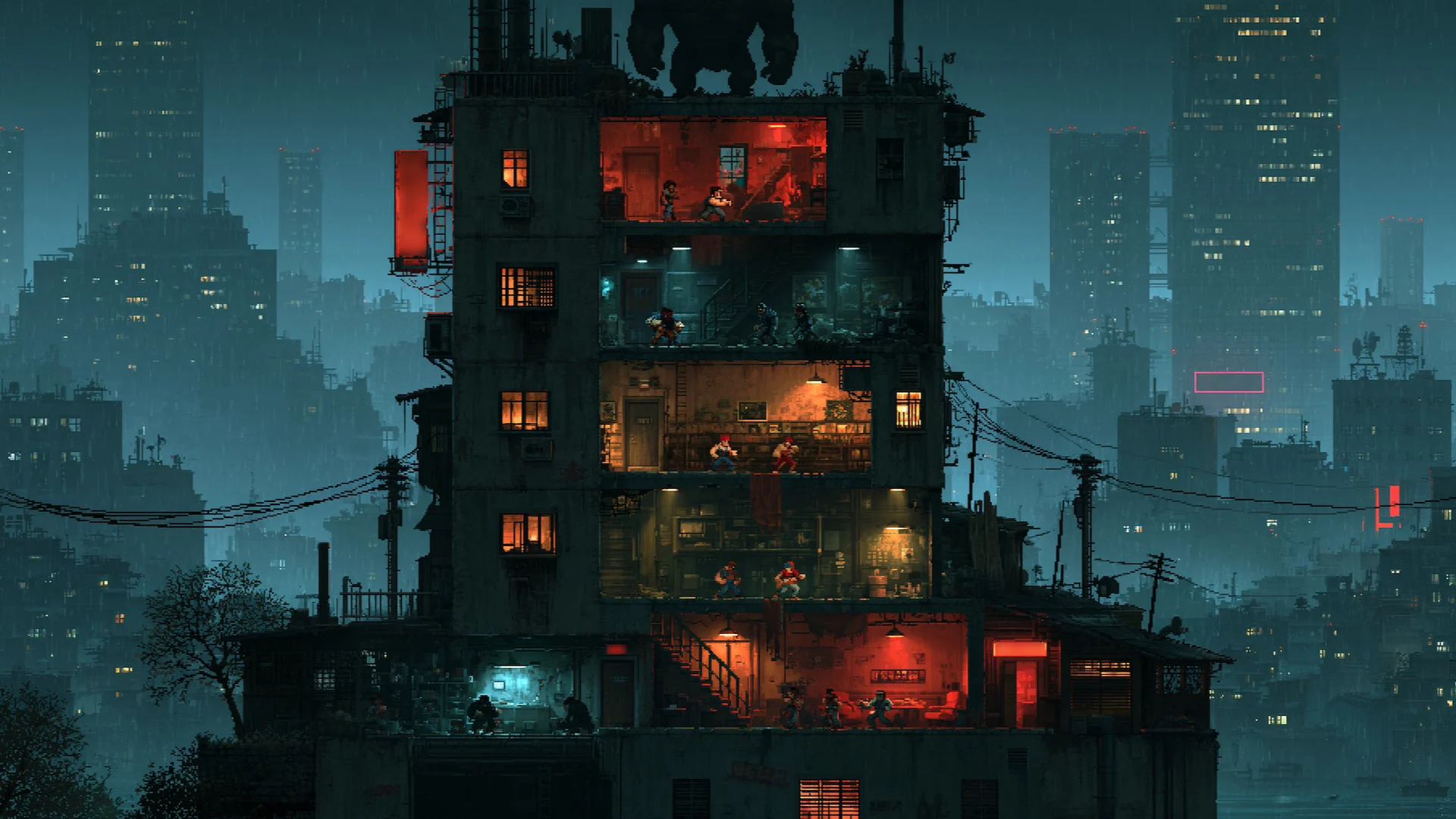
A level is a self-contained stage of a game, usually harder than the one before it, often ending in a fight with a boss who guards the way forward. The Raid and Dredd are both built as a climb through levels, starting at the very bottom and battling through hordes of enemies to reach the top.
In The Raid (opens in a new window) (Gareth Evans, 2011), a police squad enters a 15-storey Jakarta tower block to arrest the crime lord Tama, who runs the building from the top floor. In Dredd (opens in a new window) (Pete Travis, 2012), lawman of the future Judge Dredd and a rookie, Anderson, are trapped inside Peach Trees, a 200-storey slum block, when the drug lord Ma-Ma orders it sealed with blast shields.
Read as games, the two films share a skeleton. The exits close. Resources run down. Enemies get tougher as the floor numbers climb. Each film has set pieces that work like mid-level bosses, and a final confrontation at the top.
In Dredd, Ma-Ma's gang trains rotary cannons on the 76th floor, tearing through its walls as though they were paper. It's a mind-boggling sequence of destruction that plays like a stage built around one overwhelming enemy. The Raid's standout mini-boss is Tama's enforcer, Mad Dog, who sets his gun aside to fight hand to hand. It takes two fighters working together to bring him down before anyone reaches the final baddie.
At the time, the likeness between the two films looked suspicious. But the fairer read is that they're different executions of the same core idea, and they're both excellent.
The side-scrolling struggle: Snowpiercer
A side-scroller is a game where you move across the screen, usually left to right, and the world scrolls with you. Snowpiercer (opens in a new window) (Bong Joon-ho, 2013) turns its whole setting into one.
The film comes from Le Transperceneige, a French comic by Jacques Lob and Jean-Marc Rochette first serialised in 1982. What's left of humanity rides a train that circles a frozen Earth, with the poor crammed into the tail and the rich living at the front. Chris Evans plays Curtis, who leads an uprising from the back of the train towards the engine.
Granted, the video game connection is perhaps the most tenuous here. But watch how it unfolds: each carriage is a new environment with its own look and its own threat, and the only way forward is through.
The group fights one battle in total darkness as the train enters a tunnel, then moves on through a greenhouse, an aquarium with a working sushi bar, a meat freezer, a classroom where a teacher leads the children in a song and then pulls a gun, a sauna, and a nightclub full of people.
The swerves in tone are the method. A game changes the wallpaper at every stage and expects you to keep moving forward, and the director does the same, so that the closer Curtis gets to the engine the less the train resembles anything he's seen from the place where he began. Worse, the rebellion loses fighters at almost every door, the way a squad of characters thins out over a long game.
The boss fights: Scott Pilgrim vs. the World
Scott Pilgrim vs. the World (opens in a new window) (Edgar Wright, 2010) is a film-slash-comic-slash-multimedia-extravaganza that's unabashedly about games. Based on a cult series of comics by Bryan Lee O'Malley, Scott is a 22-year-old bassist who falls for Ramona Flowers in snowy Toronto, then learns he has to defeat her seven evil exes in order to date her.
The references start before the story does. The Universal logo plays in 8-bit, the blocky graphics and beeping sound of 1980s consoles, and the opening scene uses music from The Legend of Zelda. Defeated exes burst into coins, a convention likely popularised by the classic NES beat 'em up River City Ransom.
But the film is much more than a series of knowing winks. Underneath, it uses the structure of boss fights to tell us something about relationships. Each ex is a piece of Ramona's history that Scott has to face, and the fights keep exposing his own. Near the end, the final boss kills him. Undaunted, Scott spends an extra life he picked up earlier and goes back in, and this time he wins because he's owned up to the people he hurt along the way.
Oh, and hey, let's not forget that the movie spawned a licensed video game tie-in that paid loving homage to River City Ransom (while also being bags of fun in its own right).
Credits roll
Films are an audio-visual medium. Video games are another. Most of the time they stay in their respective lanes and deliver what audiences expect of them. But it's fascinating to see the direction of travel for creativity, especially as generations of artists who grew up as gamers parlay their preoccupations elsewhere.
The direction of travel goes both ways, too. Alien was a huge influence on Metroid according to designer Yoshio Sakamoto (opens in a new window), while Castlevania paid extensive homage to Dracula. Director Hitoshi Akamatsu said (opens in a new window) the team "wanted players to feel like they were in a classic horror film". The end credits spoof horror actors instead of listing the developers, and Christopher Lee appears as "Christopher Bee".
Each film here takes one mechanic and hands it over to the protagonist. Cage gets the checkpoint, and it gives him the nerve to take risks. The squad in The Raid and the judges in Dredd get the climb, and it fully tests their mettle. Curtis gets the scroll forward, and every carriage shows him more of the world he was shut away from. Scott gets the boss fights, and each one brings him a step closer to maturity.
The upshot is that the line between mediums will continue to blur as time passes. Soon we might be asking ourselves: is it a film or is it a video game? The answer will be... yes.
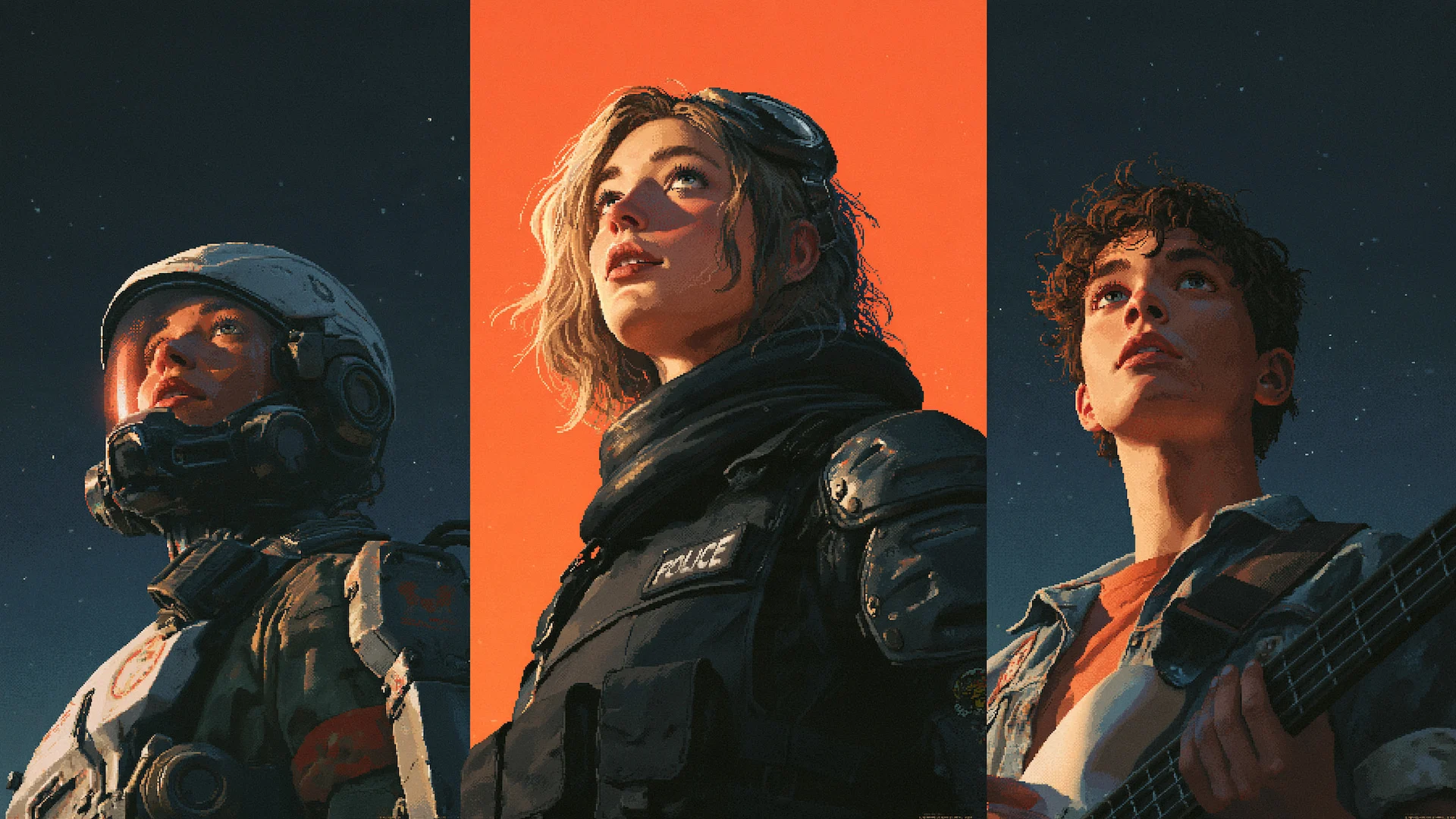
triptych, three tall vertical panels side by side like a 1990s arcade character select screen, each panel shows one character from the waist up, each figure centred in its panel with space around it, eye-level camera, chin level, eyes lifted slightly upward, lips parted in awe at something enormous off camera, all three in the identical three-quarter pose facing left, left a soldier in an exoskeleton, centre a riot police officer in black tactical gear, right a scrappy young bassist gripping a bass guitar, the same warm light falling on all three faces, centre panel background bright orange, outer panels dark night sky, 16-bit pixel art, hard pixel edges, limited palette, no textAbout the authors